Report Background
On August 11, the National Energy Administration (NEA) officially released the “China Hydrogen Energy Development Report (2026).” Spanning 52 pages, the report provides a systematic review of China’s domestic and international hydrogen energy industry in 2025 across six key dimensions: policy framework, industrial scale, technology and equipment, major projects, standards and regulations, and international cooperation.
This report is information-dense. After reading it in full, we have distilled nine key signals.
Signal 1: Renewable Hydrogen Production — Under-Construction Capacity Is 3.6 Times Operational Capacity
Operational capacity exceeds 250,000 tonnes per year, with over 900,000 tonnes per year under construction—more than doubling year-on-year. Northeast China accounts for 46%, North China 30%, and Northwest China 22%. Green ammonia operational capacity exceeds 700,000 tonnes per year, and green methanol exceeds 380,000 tonnes per year.
Analysis: Under-construction capacity being 3.6 times operational capacity signals a concentrated capacity release in the next 1–2 years. The three northern regions are the main battleground, and hydrogen-ammonia-methanol integration has become the clearest flagship model of the 15th Five-Year Plan.
Signal 2: Hydrogen Storage and Transportation — From Tube Trailers to Pipelines
Over 20 pure hydrogen pipelines are planned with a total length exceeding 5,500 kilometers, of which more than 350 km are already built. The 195-km Damao Banner–Baotou pipeline has been fully completed, and hydrogen transportation costs are expected to drop from 13 yuan/kg to 3 yuan/kg. 30 MPa tube trailers are now in operation, reducing per-vehicle transport costs by approximately 30%. 52 MPa Type IV hydrogen storage cylinders have been successfully developed, enabling each vehicle to carry over 1,000 kg of hydrogen.
Analysis: Piping is the most definitive path to reducing storage and transportation costs. Whether it is pipeline pressurization, tube trailer filling, or hydrogen station pressure boosting, all these stages rely on compressors. Every upgrade on the transportation and storage front raises the bar for compressor performance and reliability.
Signal 3: 590 Hydrogen Refueling Stations — Quantity Is Sufficient, Utilization Is the Challenge
Over 590 hydrogen refueling stations have been built nationwide. According to industry survey data, fewer than 10% are profitable. Most stations dispense less than 300 kg per day, far below the 500 kg breakeven threshold. The average production-side price is 26.2 yuan/kg, while the consumer-side price averages 44.5 yuan/kg.
Analysis: The core challenge has shifted from “how many stations have been built” to “can they operate efficiently?” The 18 yuan/kg price gap between production and consumption sides represents storage, transportation, and dispensing costs. Daily dispensing volume is the prerequisite for profitability, and equipment reliability and operational efficiency directly determine whether a station can cross the breakeven line.
Signal 4: China’s Hydrogen Products Begin Exporting at Scale
5,000 tonnes of green methanol were shipped from Tianjin Port to Singapore; 150 tonnes of green ammonia departed for Belgium. Chinese electrolyzer manufacturers are building a China-Europe industrial chain through a model of technology transfer plus European assembly. The Jilin Songyuan project has obtained EU ISCC certification.
Analysis: The shift from “equipment exports” to “full-chain export of products, technology, and engineering” represents a qualitative change. The threshold for international markets is not just product capability, but also certification and carbon accounting systems.
Signal 5: Standards Framework Accelerates — The Industry Enters the Era of “Professional Players”
In 2025, more than 10 national standards and approximately 20 industry standards were published. Standards from the Ministry of Industry and Information Technology explicitly include specifications for diaphragm hydrogen compressors used in hydrogen refueling stations. Over 80 hydrogen energy standards have been published under ISO/IEC, with nearly 20 new releases in 2025. Carbon accounting methodologies have become the core focus of standards competition.
Analysis: The rapid rollout of standards indicates that the industry is moving from “whatever works” to “standards-based compliance.” For equipment companies, standards create thresholds, and thresholds create differentiation—companies with solid technology will benefit.
Signal 6: Global Hydrogen Consumption Reaches Approximately 109 Million Tonnes — China Leads
Global hydrogen production and consumption reached approximately 109 million tonnes in 2025, a year-on-year increase of about 3%. Fossil fuel-based hydrogen still accounts for 84% (natural gas: 61%, coal: 23%). Global renewable energy electrolysis-based hydrogen production capacity has reached approximately 500,000 tonnes per year cumulatively, with over 200,000 tonnes per year added in 2025. China and Europe together account for over 70% of global renewable hydrogen capacity, with China alone holding 53%.
Analysis: The global hydrogen industry continues to grow steadily. Fossil fuel-based hydrogen remains the dominant force, but renewable hydrogen is the fastest-growing segment. China’s capacity share in this segment exceeds half—making it the undisputed world leader.
Signal 7: Multi-Scenario Bloom — Transportation, Industry, and Power Generation Advance Across the Board
The fleet of fuel cell vehicles stands at approximately 32,000, with nearly 8,000 units promoted nationwide in 2025. Over 10 hydrogen-fueled vessels are in operation and over 330 are under construction, accounting for 17% of alternative fuel vessel orders. More than 30 hydrogen-powered drone models have been released or completed test flights. Approximately 29,000 hydrogen-powered two-wheelers have been deployed. Over 20 hydrogen passenger/freight trains and rubber-tired rail vehicles have rolled off production lines. Cumulative operational fuel cell power generation and combined heat and power (CHP) projects exceed 130, with installed capacity surpassing 30 megawatts.
Analysis: Hydrogen application scenarios have expanded from a single breakthrough in transportation to a multi-front advance across transportation, industry, and power generation. While the demonstration period for fuel cell vehicle city clusters has ended, the achievements in equipment localization and supply chain development have been solidified. The more diverse the scenarios, the higher the requirements for equipment adaptability.
Signal 8: Carbon Accounting Becomes a New Front in International Competition
The Ministry of Ecology and Environment and the National Energy Administration have released CCER methodologies for renewable energy electrolysis-based hydrogen production. The EU Carbon Border Adjustment Mechanism (CBAM) is now in full operation, requiring full life-cycle carbon emission traceability. The United States has revised its hydrogen production carbon emission accounting model, directly linked to tax credits.
Analysis: In the future, hydrogen’s competitiveness will not just be about “producing it cheaply” but also about “accounting for it clearly.” For equipment providers, the ability to precisely measure and trace energy consumption data at every stage is becoming a new dimension of competitive advantage.
Signal 9: Global Landscape — 66 Countries with Strategic Plans, Hydrogen Globalization Accelerates
The number of countries and regions that have released hydrogen strategies has reached 66, accounting for over 90% of global GDP. The EU has invested €184.5 million to promote hydrogen production, storage and transportation infrastructure, and transportation applications. Japan has allocated a special budget of 5.7 billion yen to support low-carbon hydrogen and derivative hubs. The EU Hydrogen Bank’s second round has awarded €2.706 billion in support to 6 winning projects. The Global Green Shipping Corridors initiative has exceeded 80 projects, a year-on-year increase of approximately 35%.
Analysis: The world’s major economies are investing real money in hydrogen energy. The EU, Japan, and the United States are intensifying both policy and financial support. The opportunity for Chinese companies lies not only in “selling equipment” but also in participating in the division of labor in the global hydrogen value chain—advancing technology transfer, engineering services, and product trade simultaneously.
Summary
After reading the 52-page report, the core signal is clear: the hydrogen industry is transitioning from pilot demonstration to the eve of large-scale deployment.
900,000 tonnes of under-construction capacity have yet to be released. Over 5,500 kilometers of pipelines are still in planning. The utilization rates of 590 hydrogen refueling stations are still climbing. The volume explosion has not truly arrived, but the standards and market structure are already taking shape.
And Dondel Hydrogen has long been positioning itself in this race for strategic advantage.
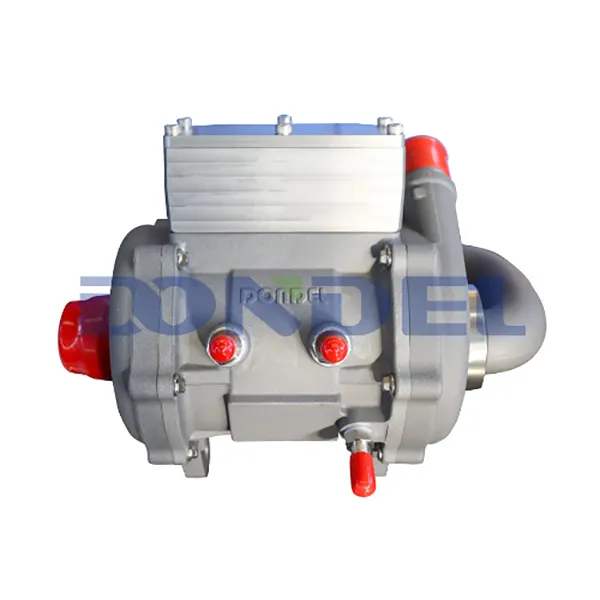
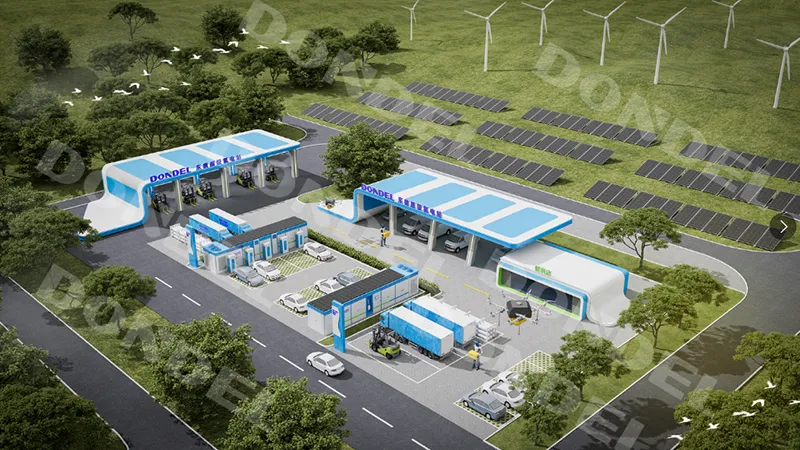
On the storage and transportation efficiency front, the world’s first ionic liquid sealed compressor achieves discharge pressures above 100 MPa with zero leakage in the compression chamber, while Dondel’s independently developed 90 MPa high-pressure diaphragm compressor—the first of its kind in China—fills a domestic gap. On the scenario adaptability front, Dondel’s business spans the full chain from “production, storage, transportation, refueling, to application,” with the PowerMax Super Hydrogen Station selected as a landmark application scenario in Shandong Province’s new energy sector.
The technology seeds that Dondel has planted are taking root at every strategic position highlighted in this report. When the wave of large-scale deployment truly arrives, what Dondel aims to do is not to rush to catch up, but to lead with a solid foundation.